

Is Your Runway Model Actually Board-Ready? Ask It These 12 Questions First
Here's a scene I've watched play out in more boardrooms than I can count.
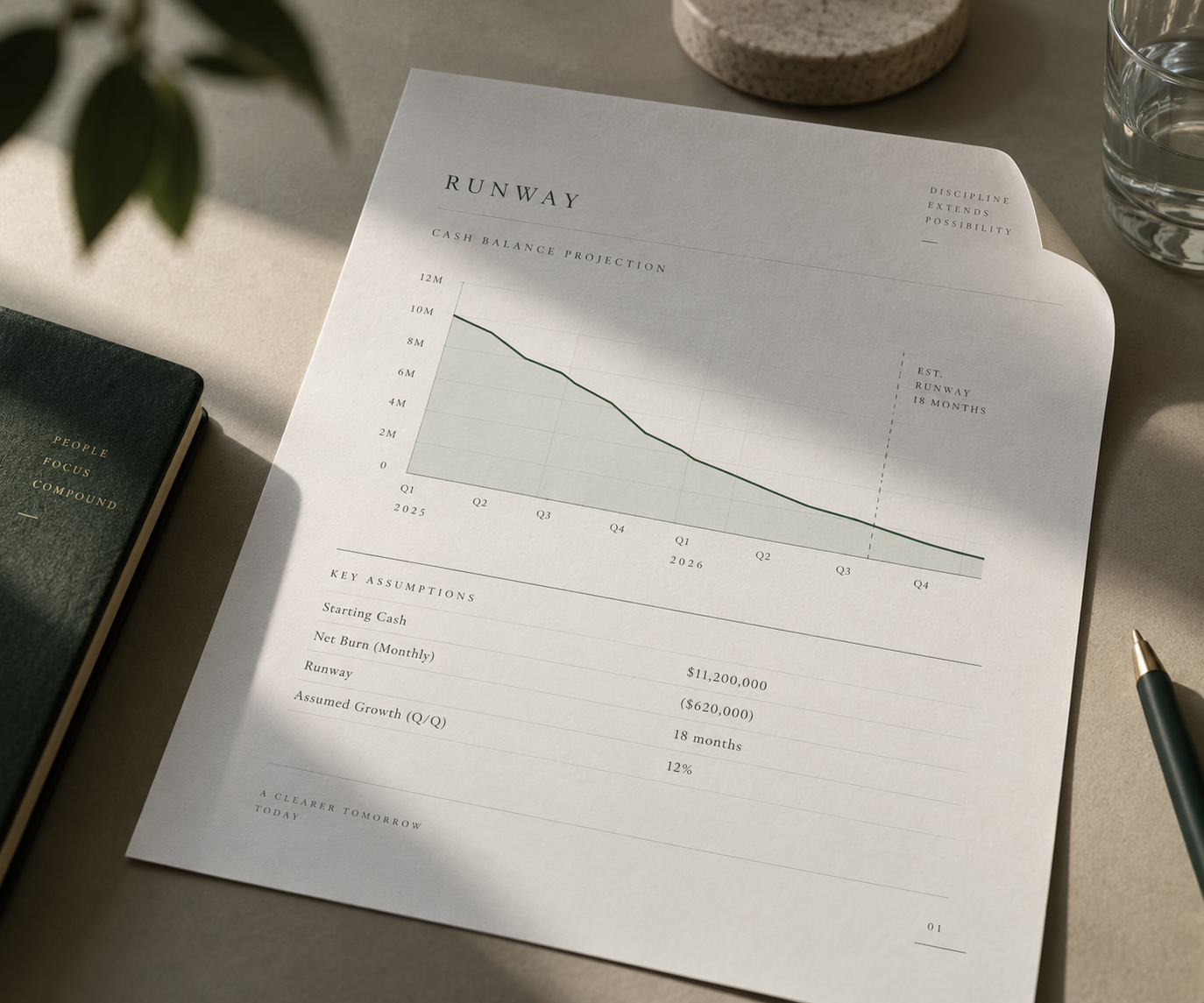
A founder pulls up the runway slide. Confident. Rehearsed. Then a board member asks one follow-up question, something simple like "what happens to that number if the enterprise deal slips a quarter?" And the founder freezes, because the model behind that slide was never built to answer it. It just spits out one number and hopes nobody pokes at it.
That's not a board-ready runway model. That's a guess wearing a nice font.
A board-ready runway model isn't the one with the prettiest chart. It's the one that survives being poked at, from six different directions, by people whose job is literally to poke at it. If your model only works when nobody asks a follow-up question, it isn't a model. It's a hope.
What actually makes a runway model trustworthy
Here's the part that surprises founders: board members don't distrust your numbers because the numbers are bad. They distrust them because nobody can explain where they came from. A runway model earns trust the same way a person does, by being consistent when someone pushes on it.
That means the assumptions underneath your cash position, your burn, and your fundraise timeline all have to hold together under questioning. Not just look good on a slide. Actually hold together, out loud, in a room, when a board member who's seen forty of these decks starts asking "why."
So before your next board meeting or your next round, run your model through these twelve questions. If it can't answer all twelve without you scrambling for a side spreadsheet, it isn't ready yet, and that's fixable before the meeting, not during it.
The 12 questions your model has to survive
On cash and runway:
What's our exact cash position today, reconciled to the actual bank balance, not to a plan built three weeks ago?
How many months of runway do we have at current burn, and would finance and the CEO give the board the same number if asked separately?
What's the single biggest assumption baked into that runway figure, and what breaks if it's wrong?
If we needed to stretch runway starting tomorrow, what would we actually cut, and how many months would that buy us?
On burn rate and unit economics:
What's our burn rate broken into fixed versus variable costs, not one blended number that hides where the flexibility actually is?
Is burn growing faster than revenue right now, and can we explain why in a single sentence?
Is gross margin improving or eroding as we scale, and does the model reflect that trend or just today's snapshot?
For every dollar we put into growth, what's coming back, and over what time horizon?
On scenario readiness:
What does the model say happens under a slower-than-planned sales quarter, not the plan quarter?
What does it say if the next fundraise takes six months longer than hoped?
On fundraising alignment:
How much are we raising, why that specific number, and how many months of runway does it actually buy?
Does this model match, line for line, the story we're telling investors in the deck sitting next to it?
Twelve questions. Not because it's a tidy number, but because that's roughly where the real risk in a startup's finances tends to live: today's cash, tomorrow's spending discipline, next quarter's surprises, and the story you're telling the people writing checks. Miss one category and you haven't de-risked anything, you've just found a new way to get caught off guard.
Why most models fail before question three
Honestly, most runway models don't fail because the math is wrong. They fail because they were built once, in a rush, before a fundraise, and never touched again. The assumptions calcify. Nobody updates the churn number after three customers leave. The burn breakdown was accurate in March and it's now September.
A model like that isn't lying to you exactly. It's just old, and old models get exposed the moment someone in the room asks a question the spreadsheet was never rebuilt to answer.
This is where a lot of finance advice quietly goes wrong: it treats the model as a deliverable instead of a living thing. You don't build a runway model once and ship it like a slide deck. You maintain it the way you'd maintain any system you're betting the company on.
Structure is what makes the model survive scrutiny
A board-ready model isn't just accurate on the day you build it. It's built to keep being accurate as reality moves.
That means real scenario modeling, best case, worst case, and the case that's actually most likely, not just a single "base case" dressed up to look thorough. It means your assumptions are documented somewhere a board member could actually find them, not buried in a formula six tabs deep. And increasingly, it means the update cycle is fast enough that "today's numbers" actually means today, not three weeks ago.
That last part is where AI genuinely earns its place in finance operations, and it's worth being precise about what it does and doesn't do. AI can pull live data from your systems, reconcile transactions, and get your close down close to real time, which means your runway model can reflect this week instead of last quarter. What it can't do is replace the judgment that decides which scenario actually matters for your business, or catch the strategic implication of a slipping deal. AI handles the routine work of keeping the numbers current. A human still has to drive what those numbers mean.
That's the whole philosophy behind how we build finance functions at SISU: workflow before automation. We don't hand a founder a faster spreadsheet. We fix the underlying process so the model is trustworthy in the first place, then use AI to keep it current without losing the judgment that makes it useful.
The takeaway
A board-ready runway model isn't the one that looks finished. It's the one that survives being questioned, because it was built to be questioned in the first place.
If you can't answer all twelve of these right now, that's not a crisis, it's just information. It tells you exactly where the next hour of finance work should go before your next board meeting, not after someone on your board finds the gap for you.
If you want a second pair of eyes on your model before it's in front of your board, we'd be happy to look at it with you. Sometimes it needs an hour of cleanup. Sometimes it needs a rebuild. Either way, better to find out from us than from a board member mid-meeting.
