

Burn Rate and Runway: Done Right!

You're running low on cash. You probably don't know exactly how low, and you definitely don't know exactly when you run out. That's the problem.
I ask founders about their burn rate and runway at almost every meeting. And I get the same answers: either blank stares, or a rough guess that's usually wrong by months. "We've got maybe six months?" they say. Then I look at the actual P&L and it's three. Or nine. The confidence is the same regardless.
Here's what matters: burn rate and runway aren't academic metrics. They're the difference between having options and having an emergency. Between being able to plan your next hire and being in crisis mode trying to cut costs. Between raising money on your terms and raising money because you're desperate.
Every founder needs to know these numbers cold. Not as a back-of-napkin estimate. As an exact calculation you check every month, the way you check your bank account.
What you're measuring
Burn rate is simple: how much cash are you spending per month, on average? If you spent $150K last month and $140K this month, your burn rate is roughly $145K per month.
Runway is how long your cash lasts at your current burn rate. If you have $500K in the bank and you're burning $100K per month, you have five months of runway.
That's it. No magic, no consultant jargon. Money going out. Money you have left. Time until it's gone.
The tricky part is doing both calculations correctly.
How to actually calculate burn rate
Monthly burn is straightforward: add up everything you spent from operations in a given month. Salaries, cloud services, office rent, sales and marketing, contractors, everything. That's your burn.
But here's where founders get it wrong: they either include things they shouldn't (like one-time CapEx, or a loan repayment that's not operational expense), or they calculate it wrong by looking at net income instead of cash outflow.
Cash outflow and net income are not the same. You might have negative net income but positive (or lower) cash burn if you're depreciating an asset. You might have positive net income but higher cash burn if you're building inventory or taking on receivables.
Pull your actual bank transactions. Add up everything that left your account for operational expenses. That's your burn.
For a more accurate picture, calculate a trailing average: take the last three months of burn, add them up, divide by three. This smooths out the one-off months where you paid a quarterly bill or made a big purchase. A trailing burn rate is more useful for planning than any single month.
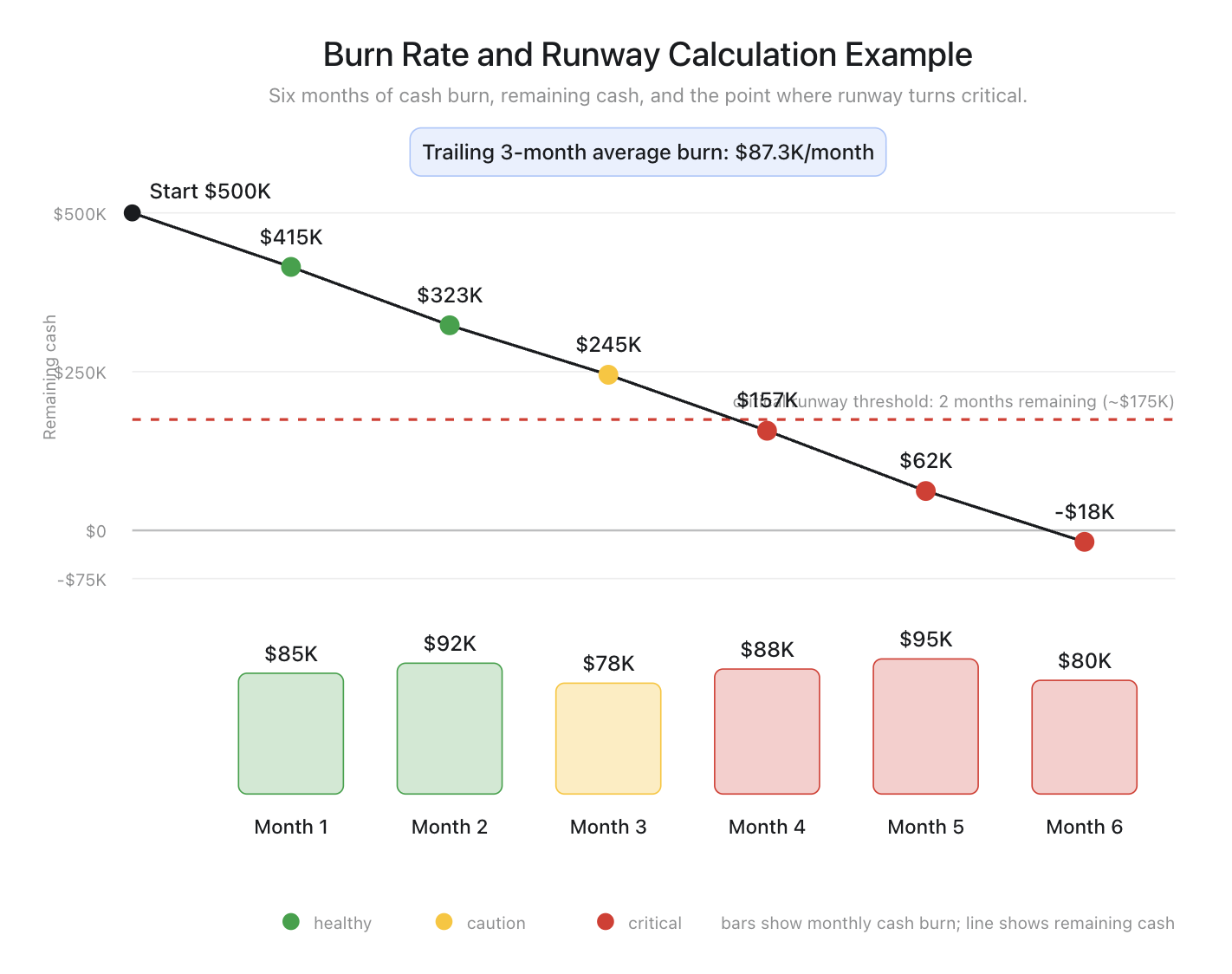
Graph: Burn Rate and Runway visualization
The runway calculation people get wrong
Runway math is not: Cash / Burn Rate = Months. Well, it is. But not the way most founders do it.
The mistake: taking your current cash balance and dividing by last month's burn. That works if last month's burn is identical to next month's. It's not.
Better approach: take your current cash, subtract what you know you'll need to spend next month (payroll, commitments), then divide by your trailing average burn. That gives you a realistic picture: not all your cash is liquid, some of it's already committed.
More realistic approach: build a three-month cash forecast. Look at your committed expenses (payroll, rent, contracts) and project burn month-by-month. Then calculate runway from there. This accounts for the fact that burn changes. It usually goes up when you hire, down when you cut.
The critical thing most founders miss: runway isn't a fixed number. It changes as burn changes. As you grow, as you hire, as revenue increases or decreases. If you raise money, your runway changes. If you cut costs, it changes. If your customers pay slower, it changes.
This is why you need to recalculate it every month. Not every quarter. Every month. And when you're below six months, every week.
Why burn rate isn't what you think it is
Here's the thing that separates founders who survive from those who don't: burn rate isn't good or bad. It's contextual.
A burn rate of $200K per month sounds scary if you're pre-revenue. It's irrelevant if you're doing $1M in monthly revenue and growing. It's healthy at $500K per month if you're Series B with strong unit economics.
I see founders fall into two camps, and both are wrong:
Camp 1: "I need to minimize burn at all costs." These founders cut so aggressively that they lose the ability to grow. They don't hire sales people because of burn. They don't invest in product because of burn. They optimize for survival, not for building a business. And they usually survive just long enough to run out of money anyway, because they're not growing fast enough to raise again.
Camp 2: "Burn is fine because we're growing fast." These founders spend like they have infinite capital and convince themselves that growth justifies the cash outflow. Until it doesn't. They hit a wall — market slows, customer acquisition gets harder, fundraising gets delayed — and suddenly they're out of runway with no cushion and no plan.
The right way to think about burn: burn should be aligned with your growth and your fundraising timeline. If you're pre-Series A and will need to raise in 18 months, your burn should get you there with a comfortable cushion. If you're Series B with a path to profitability, your burn should be declining quarter-over-quarter.
The psychological trap: Founders often raise money and then immediately increase burn to match the capital. They don't extend runway. They just spend faster. That gives you three months of cushion instead of 12. It's a classic founder mistake.
How to extend your runway without cutting aggressively
There are three levers: increase revenue, decrease burn, or raise money. Most founders jump straight to "raise money" because it feels less painful. But there's a lot of room between where you are and that decision.
First, stop the bleeding on everything that's not working. Do a burn audit. Look at each expense category: what's directly tied to growth? What's nice to have? What's a sunk cost you can't get back? Cut the things that aren't driving revenue or directly supporting product/engineering.
This doesn't mean cutting salaries or going full survival mode. It means being ruthless about marketing spend that's not working, software subscriptions you're not using, and team members who aren't delivering.
Second, accelerate revenue. This is harder than cutting costs but way more valuable. If you can get even one big customer, one committed contract, one clear revenue signal, it changes everything. It gives you leverage with investors. It extends runway. It makes the story real.
Third, think about capital efficiency. Are you spending $50K to close a $30K annual contract? That's a burn problem, not a growth problem. Can you get lean on customer acquisition? Can you focus on the cohort of customers who pay faster, renew faster, buy more? That changes your cash flow without cutting heads.
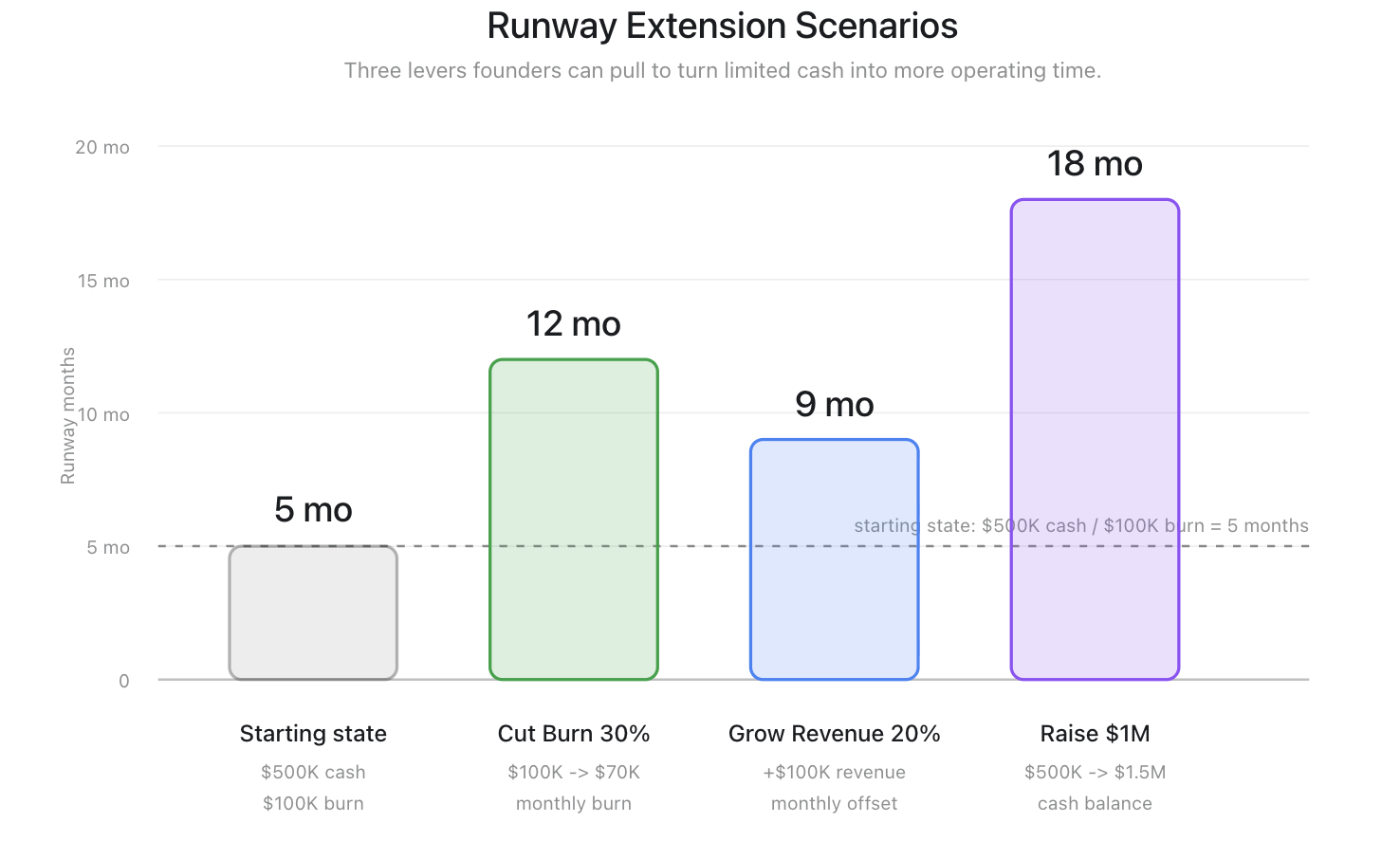
Visualizations of decisions that impact runway
The discipline piece (which is actually harder than the math)
Once you know your burn and runway, you need to act on it. Not with panic. With discipline.
If you have 12 months of runway, you don't have time to waste. You have time to be strategic, but not to be indecisive. Know what you're trying to achieve in the next 6 months. Not "grow" — specifically. Close these customers. Hit this growth target. Get to this revenue level.
If you have 6 months, you're in decision mode. Should you raise? Should you cut? Should you find a strategic investor? Decide in the next month, execute in the next four, and use month six as a cushion.
If you have 3 months, you're in crisis mode. This is where the game changes. You're raising because you have to, not because you want to. You're cutting because you have to, not because you want to. You've lost the ability to be strategic.
The best founders I work with never let themselves get to month three. They know the math, they see it coming, and they act early. That means making hard decisions while you still have options. Raising money with confidence, not desperation. Cutting costs while you can do it thoughtfully, not in panic.
Most companies die of cash starvation, not bad product. And most of them saw it coming. They just didn't do the math, or they did the math and didn't act on it.
Know your burn. Know your runway. Check it every month. Act before you have to. Everything else is noise.
