

EBITDA: The Metric to Understand
When I sit down with a founder to review their financials, one of the first questions I ask is: "Walk me through your EBITDA." Half the time, I get a blank stare. The other half, I get a number that's either wildly inflated or completely wrong.
Here's the thing: EBITDA matters. Not because it's some magical number that VCs worship — they do, but that's not the point. EBITDA matters because it's the cleanest way to see whether your core business is actually working, stripped of financial engineering and accounting decisions that have nothing to do with whether you can sell your product and make money doing it.
But most founders either don't understand it, or they understand it wrong. And that gap costs money.
Let me walk you through what EBITDA actually is, why it's different from what's sitting at the bottom of your P&L, and what it does and doesn't tell you.
What EBITDA actually is
EBITDA stands for Earnings Before Interest, Taxes, Depreciation, and Amortization. In plain English: it's your operating profit before the stuff that accountants care about but that doesn't reflect how your business actually works.
Here's the math. Start with net income — the number at the bottom of your P&L that everyone looks at:
Then work backwards. Add back:
Taxes — state, federal, whatever you paid or owe. Different legal structures pay different amounts. This is accounting, not your business.
Interest — what you paid on debt. This is a financing decision, not an operational one. You could have raised equity instead and paid zero interest.
Depreciation and Amortization — the non-cash accounting deduction for equipment or intangible assets you bought. You spent the cash when you bought the asset, not every month after. This is a timing thing, not a real expense right now.
What you're left with is EBITDA: the cash your business generates from operations, before financial decisions and accounting noise.
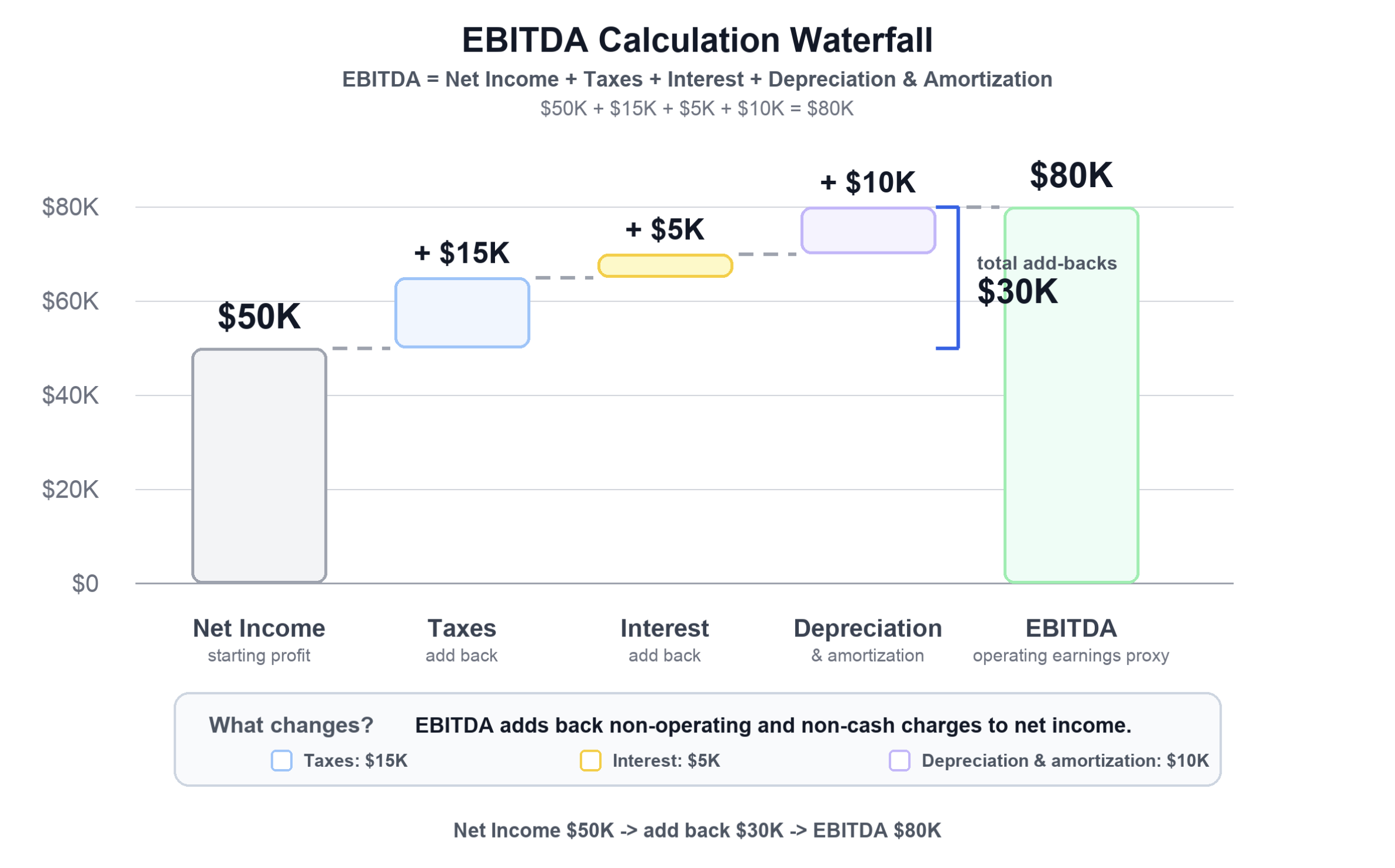
Why it matters: EBITDA shows you whether your core business engine is healthy. Not whether you picked the right debt structure, or bought too much equipment, or set up as an LLC instead of an S-corp. Just: are you making money from what you do?
Why investors obsess over EBITDA
VCs and acquisition buyers use EBITDA because it's one of the few numbers you can actually compare across companies.
Think about it: two SaaS companies with identical revenue and operating leverage might have completely different net incomes because one financed their office with a $5M loan (paying interest) and the other raised equity (paying zero interest). Same business, different bottom line. EBITDA cuts through that noise.
When a buyer looks at your company with the intention of buying it, they don't care about your interest expense — they'll refinance anyway. They don't care about your tax structure — they'll optimize it. They care about whether the core business makes money. That's what EBITDA measures.
And when VCs value your company, they use EBITDA multiples. "This industry trades at 8x EBITDA," they'll say. That means if you're doing $500K in EBITDA, your company is worth roughly $4M (before growth premiums, risks, and market conditions). The multiple varies by industry — SaaS companies trade higher, manufacturing lower — but EBITDA is the denominator.
The key insight: If you can improve your EBITDA, you don't just improve cash flow. You improve the multiple VCs will pay. A founder who gets to $1M EBITDA is worth dramatically more than one stuck at $500K, even if revenue is similar.
What EBITDA is not
Here's where founders go off the rails.
EBITDA is not cash. You can have positive EBITDA and run out of cash next month if you have big CapEx, customer payables that are 120 days, or debt principal due. EBITDA adds back depreciation (a non-cash item) but doesn't account for actual cash leaving your account.
EBITDA is not a reason to ignore real costs. Some founders say, "My EBITDA is strong, so the depreciation and taxes don't matter." Wrong. You did spend that cash on equipment. You will pay those taxes. EBITDA is a useful metric. It's not an excuse to ignore reality.
EBITDA is not comparable if someone's adding back questionable items. Some founders add back "one-time" expenses, founder salary cuts, or related-party transactions to inflate EBITDA. Investors see through this. A clean EBITDA — with standard add-backs and no creative accounting — is what matters.
How to calculate your EBITDA the right way
Start with net income. Add back these items:
Taxes paid or accrued — not deferred tax, the actual cash or liability
Interest paid — on debt, not equity
Depreciation and Amortization — both
Stock-based compensation — if you issued equity to employees (this is a non-cash charge)
That's it. Don't add back rent, marketing spend, or other operating costs. Those are real costs to run the business.
If you're reporting EBITDA, make sure you label add-backs clearly. If you add back anything unusual, explain it. The investor or buyer reading your financials needs to understand exactly what you calculated and why. Transparent EBITDA builds trust. Fuzzy math kills deals.
Why this matters for your business
Here's the operative question: why should you care about EBITDA if you're not raising money or selling?
Because EBITDA is the metric that tells you whether you can afford to grow.
Can you hire that person? Only if your EBITDA supports it. Can you take on debt? Your lender will want to see EBITDA — they need to know you generate enough cash to service it. Can you fund operations through a downturn? Your EBITDA tells you how much cash you have available after covering core operations.
Founders who manage to EBITDA — who obsess over unit economics, gross margin, and operating expenses — are the ones who keep the lights on when things get tough. And the ones who have room to invest in growth when conditions are good.
Most companies don't fail because they have a bad idea. They fail because they never got to a point where their core business was profitable. EBITDA is how you know if you're getting there.
The founders who win at this aren't the ones with the biggest revenue. They're the ones who understand their unit economics cold, manage their EBITDA ruthlessly, and know exactly how much they need to grow before the business can fund itself. Know your EBITDA. Know what it takes to improve it. Everything else is noise.
