

Margin vs. Markup: The Math That Trips Up Every Founder
One of the first things I do when I sit down with a founder is ask about their gross margin. The answers I get fall into two buckets: founders who know exactly what their margin is, and founders who guess — usually wrong.
Here's the kicker: most of the founders guessing aren't being careless. They're confusing margin with markup, which is an easy mistake to make. And it's one that costs real money.
Let me walk you through why it matters.
Markup is not margin. (They're not even close.)
A 50% markup looks great. You buy something for $100, add $50, sell it for $150. Seems straightforward. But that's not a 50% margin. It's 33%.
Here's why: margin measures profit as a percentage of revenue. So in that example:
Revenue: $150
Cost of goods: $100
Profit: $50
Margin: $50 / $150 = 33%
That same $50 profit, expressed as a percentage of what you sold it for, is 33%, not 50%.
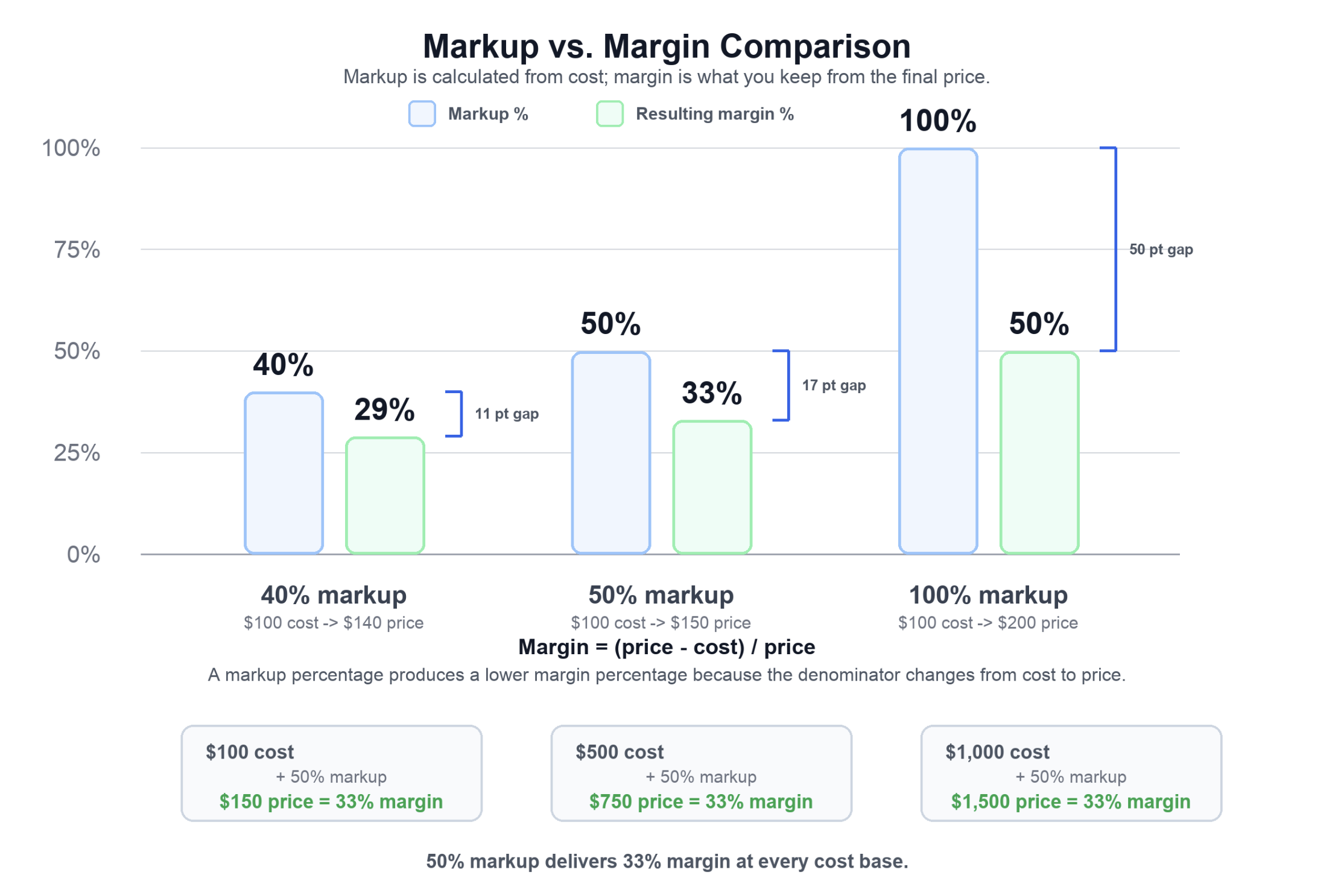
Graph: Markup vs Margin
It sounds like semantics, but it's not. When you're managing cash flow, evaluating profitability, comparing your business to competitors, or deciding whether you can afford to invest in growth — you need to be talking about margin, not markup. Margin is what investors care about. Margin is what your bank cares about. Margin is what matters.
Markup is the input. Margin is the output.
Why founders get this backwards
The confusion usually starts with how we think about pricing. If you're building a product and you know your cost to serve is $100, you do the math like this: "I need to add 50% to cover operating expenses and profit." So 50% markup. And you move on.
That math isn't wrong — it's just incomplete. That 50% markup has to cover your salaries, office, legal, customer support, cloud infrastructure, loan payments, everything that's not directly tied to making that product. And it has to leave you with actual profit on top of that.
The 50% markup might work if your other operating expenses are near zero. But they're not. And the moment you account for overhead, that 50% markup gets thin real fast.
I see this all the time with founders pricing software, services, or physical products. They start with markup thinking and then wonder why they're not hitting their margin targets. Sometimes they raise prices (good move). Sometimes they cut costs (also sometimes necessary). But usually they're just working off incomplete math.
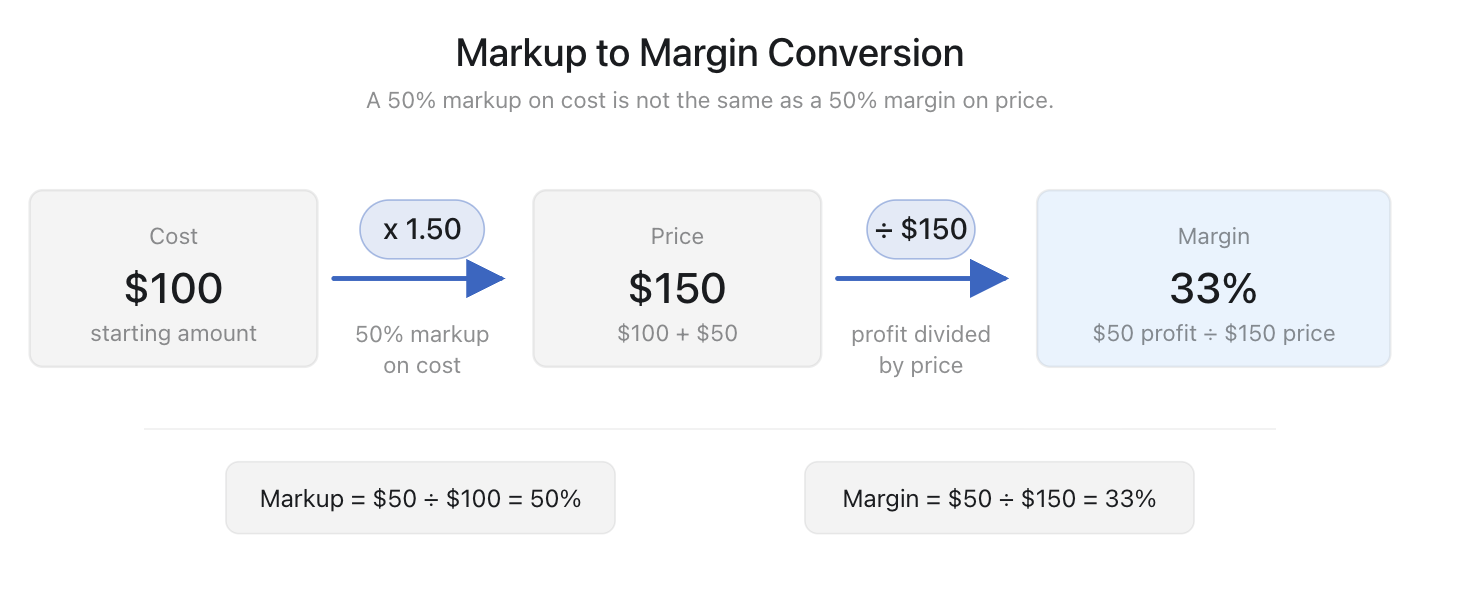
Diagram of Markup to Margin conversion
The formulas (because you need to know these)
Markup tells you how much you added to the cost:
Markup = (Selling Price - Cost) / Cost × 100%Margin tells you what's left over as a percentage of revenue:
Margin = (Selling Price - Cost) / Selling Price × 100%Or, if you know your margin and want to back into price (the more useful direction):
Selling Price = Cost / (1 - Margin %)So if your cost is $100 and you want a 40% margin, you need to sell it for $100 / (1 - 0.40) = $166.67. That's a 67% markup, not a 40% markup.
See the disconnect? A 40% margin requires a 67% markup. That's the gap that trips up founders.
Why this actually matters for your business
Here's a real scenario: You're running a service business. Your fully-loaded cost per project is $10,000 (labor, tools, everything). You price at $15,000 (50% markup). You think you're making good money.
Then your spreadsheet tells you something different. You're not hitting 50% margin. You're hitting 33%. And once you factor in all the time you spend on sales, operations, and things that don't directly bill to projects, your actual margin is more like 20%.
That's the problem. And it's been baked into your pricing model from day one.
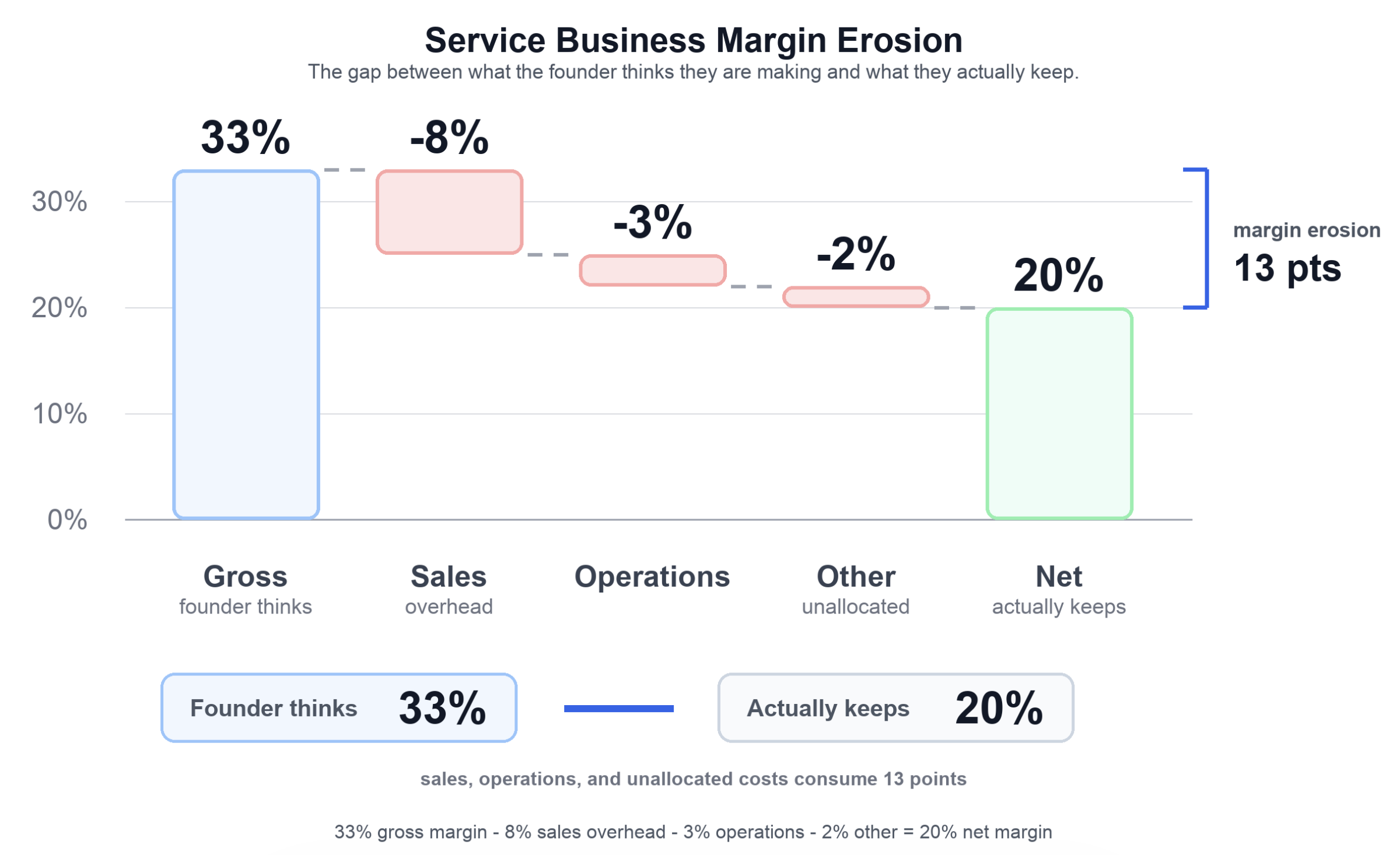
Waterfall Chart: Margin Erosion Gross Margin to Net Profit Margin
Now, 20% margin might be fine for you. Plenty of businesses operate on 20% margins. But you need to know that's the reality. You need to know if that's enough to fund growth, cover downturns, or invest in the team you're trying to build.
The founders who win at this aren't the ones with the most complicated pricing models. They're the ones who understand the math cold, calculate their margin (not their markup), and price accordingly. Then they watch it like a hawk every quarter.
According to AICPA guidance on gross margin calculation, margin analysis is foundational to understanding business profitability. And McKinsey research on pricing strategy reinforces that founders who master pricing discipline consistently outperform peers on profitability.
One more thing: gross margin vs. net margin
While we're on the subject, let me clarify one more distinction because it matters. Gross margin is profit after cost of goods, before operating expenses. Net margin is profit after everything — that's your bottom line.
So in my service example above: if you're hitting a 33% gross margin (selling price minus direct delivery costs), your net margin is lower once you account for sales, overhead, and operations.
Most of the time when we talk about "margin," we mean gross margin — at least that's what VCs and investors are asking about. But make sure you know what number you're talking about. They're not the same.
How to think about your own pricing
If you're sitting down to price something, here's the right way to think about it:
Know your true cost of delivery — all of it, not just the obvious line items.
Decide what net margin you need to hit. (This is a business strategy decision, not a math one. For a SaaS business, 70%+ gross margin. For a service business, 40-60%. For product retail, maybe 30-50%. It depends on your model.)
Back into your price from there using the formula above.
Test that pricing in the market — can you sell it? Do your customers see value? Or are you too high?
Watch your actual margin every single month. Costs creep up. Revenue doesn't always follow.
The founders who have the most control over their business are the ones who understand their unit economics cold. Not because they're spreadsheet junkies — because they know that pricing and margin are where the business either starts to scale or starts to break.
Most companies don't need more software. They need better operations. And better operations starts with knowing your numbers, not guessing them.
